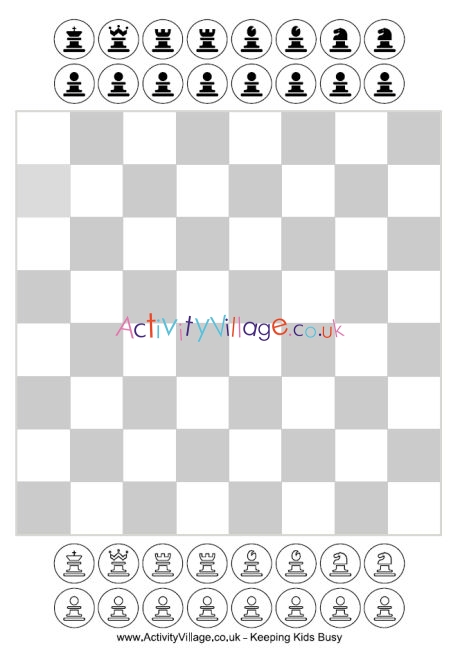
Chess is an excellent game for kids. It teaches them strategic thinking, logic and it's fun, too! We have the rules of Chess, here, written so that children can understand them. Read online or download a printable version. And if you are desperate to start playing chess straight away and don't have a chess board or chess men, we have some printable versions of those, too - one small and one large, complete with 3D chess pieces to cut out and assemble. Scroll to the bottom of the page for the printables.
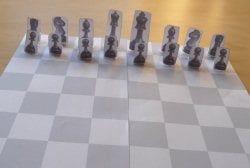
Here is the black army from our printable chess set lined up and ready for battle!
The Game Of Chess
"After a subtle contest of strategy, the White Army suddenly unleashed a devastating attack; emerging victorious by outflanking the enemy army and destroying the defences around the opposing King."
Every game of chess has its own story. Some are long-drawn out strategic affairs; others can be quick, but complicated, tactical battles. The winner is the player who can out-think his or her opponent, and make the best plans for attack and defence.
Chess is one of the oldest games in the world. Though no-one knows for sure, it was probably invented in India more than a thousand years ago . If you have a chess set, or decide to make your own, here are the rules you need to play the game.
What you need:
A chess board and pieces
Aim of the game:
The aim of the game is to use your army to capture the enemy king.
The armies:
There is a White army and a Black army. Both armies have the same pieces. These are:
| Name | Picture | Symbol | Description | How it moves |
| 1 King | 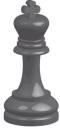 |
 |
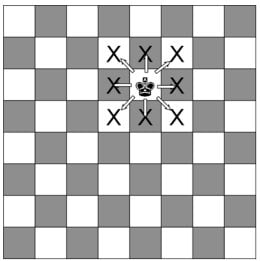
The King is the most important piece in the army. If he is captured, the game is lost. | 1 square in any direction (forward, back, across or diagonally) |
| 1 Queen | 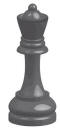 |
 |
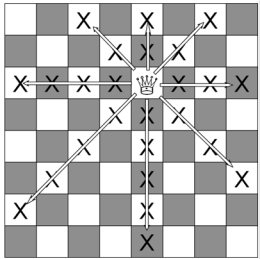
The Queen is the most powerful piece. | Any number of squares in any direction |
| 2 Castles | 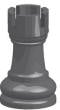 |
 |
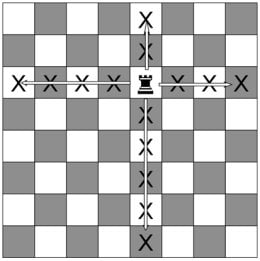
Castles are strong pieces which are good both at attacking the enemy and defending the King. Sometimes the Castle is called a Rook. | Any number of squares forward, back or across (but not diagonally) |
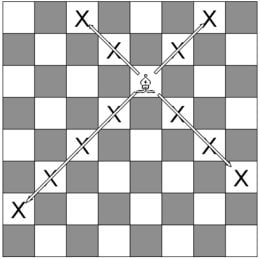
| 2 Bishops | 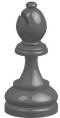 |
 |
Bishops are good at attacking late on in the game. Because they move diagonally, they always stay on the same colour square that they started on. | Any number of square diagonally |
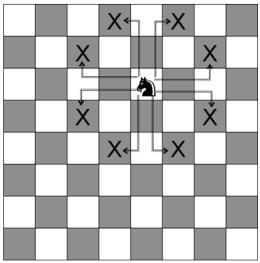
| 2 Knights | 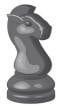 |
 |
Knights are at their best when there are lots of pieces on the board, and they can use their ability to jump over other pieces. | L shaped two squares forward (or back) and one square across; or two squares across and one square forward (or back). The Knight can jump over other pieces while doing this. |
| 8 Pawns |  |
 |
Pawns are the foot soldiers in the army. They gradually advance on the opposing army, but also need to defend the King. | Usually one square forward. If it is capturing an opposing piece, however, it moves one square forward diagonally. Each pawn may move two squares forward the first time it moves. If it does, it cannot capture in the same move. Pawns can never move backwards. |
If the description of how a piece moves isnt clear, have a look at the diagrams at the end of these rules.
How to Play Chess
You need two players. Decide who will be White and who will be Black.
Set up the board so you have a white square on the corner of the board by your right hand. Then place the armies on the board as shown in the picture below.
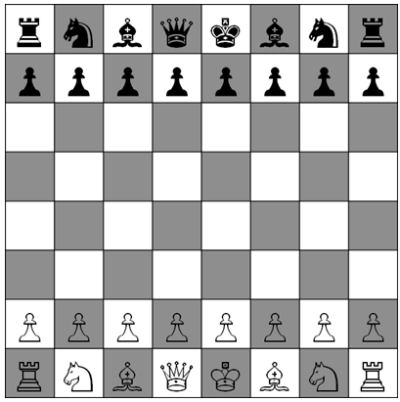
Hint: the White Queen starts on a white square, and the Black Queen starts on a black square.
White and Black take it in turns to move a piece (in Chess, the White army always goes first). Remember each piece has its own way of moving as described above. A piece can capture an opposing piece by landing on that pieces square.
The aim of the game is to capture the enemy King. If you move one of your pieces to attack the King in other words, your piece could capture him next move you say check. This means, roughly watch out for your King!.
If he or she is in check, your opponent needs to defend the King either by moving him out of the way of the attack, blocking the attack with another piece, or capturing the piece that threatened to capture the King.
If your opponent cant defend the King in any of these ways, you say checkmate. This means the king is dead. Remember that you must never move your King into check as this would mean your opponent could capture your King straightaway.
You can play a version of chess using just the simple rules above, but two additional rules make game much more exciting.
Promoting Pawns
Pawns are usually the slow-moving part of your army, but if you manage to get a pawn to the last row of the board you can promote it to be a Queen (or a Castle, Bishop or Knight if you prefer). A Pawn being promoted to a Queen can transform a game that seemed to be lost!
Castling
Castling is a quick way to get your King into a well defended position by moving towards the corner of the board. The rule sounds complicated but is simple when you get the hang of it.
If there is nothing between your King and one of your Castles; and neither the King nor that Castle have moved yet, then you can move your King two squares towards that Castle, and put the Castle the other side of the King (this is the only time a piece other than a Knight can jump over another piece).
The diagrams below show how to castle.
Before castling:
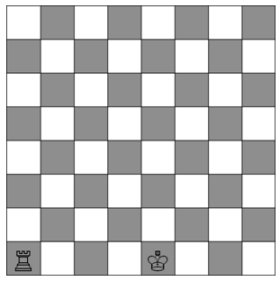
After castling:
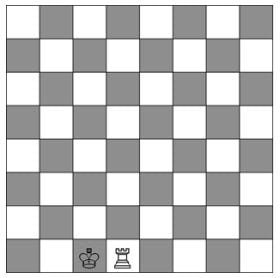
The White King moves two squares towards the Castle, and the Castle moves to the other side of the King.
One last rule on castling you cant castle if your King is in check, or if any of the squares the King moves through when castling are under attack.
How The Pieces Move
King:
Queen:
Castle:
Bishop:
Knight:
Pawn:
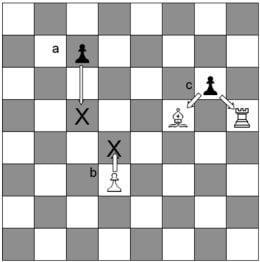
a) 2 squares forward
b) 1 square forward
c) captures
Tips
- Start off by using your central Pawns to try to control the middle of the board.
- Use your other Pawns to defend the central Pawns and each other.
- Move your Knights and Bishops out from the back row early on (this is called developing your pieces and means you are using the full strength of your army).
- Be cautious with your Queen at the start try not to waste time moving her away from enemy attacks.
- Try to keep your King defended by your Pawns (castling is a good way to do this).